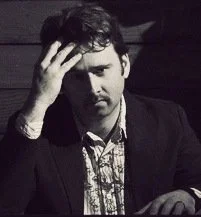
BENEATH THE DIRT FLOOR: EPISODE 01
From 2022-2023, I started writing a podcast about the late, great Chris Whitley. I’m sad to say it never made it beyond the writing phase, so I present my three completed scripts; music excerpts are included for illustrative purposes only.
BENEATH THE DIRT FLOOR:
THE MUSIC OF CHRIS WHITLEY
PROLOGUE
It’s 1992 and I’ve convinced—well, let’s call her Ramona as she’s an accidental player in this memory—I’ve convinced Ramona to drive down to Cincinnati to see Chris Whitley playing live at Bogarts. This was a first date, so it was bound to be awkward. On top of that, Chris was playing with Toad the Wet Sprocket, a lightweight folk-pop band that I loathed with a fair amount of passion. But I was on a mission, and I was going to see Chris Whitley, just not the way I imagined.
Like many of us who heard Chris Whitley’s debut album for the first time, I quickly became obsessed with it. It arrived in the summer of 1991 as a major label outlier that didn’t fit neatly into any category. To Columbia Records’ credit, they knew they had something special, but not how to sell it.
They found success with The Complete Collection of Robert Johnson only the year before, so the term “Delta Blues” was in the air, and it seemed—at least to a PR department—a brain-free association: Chris was the “new” Robert Johnson.
The album cover photo by Timothy White suggested “young blues guy.” There was Chris, standing casually against a stained yellow wall, a shadow half-obscuring his sly smile; propped next to him was his trusty National Triolian guitar (nicknamed “Mustard” I’d later learn). The interior photos played up his good looks and a knack for wearing a stretched-out tank top that barely qualified as outerwear. For me, though, the most striking visual was a sepia-toned shot of Chris with his palms against a screen door, his eyes down like he was asking for forgiveness; to be let in. The album’s visual design suggested a sun baked land on the outskirts of society. It was lonely and sweaty where this stranger was calling from, and dangerous, too; the printed lyrics bore this out in spades.
So, having listened to the album for the first time, a question you might have asked yourself: was Chris playing the blues? It had that feel, and the sound of a metal slide hitting guitar strings pointed you in that direction, but his lyrics had a surreal poetry about them and were a far cry from the straight-thinking of popular blues musicians of the time—say Robert Cray, Jeff Healy, and the recently deceased Stevie Ray Vaughn. While the guitar playing kept things bound to earth, the album’s production tapped into something ethereal. And his voice was a thing of beauty, slipping in and out of a ghostly falsetto, gliding between gritty and sublime and tying the two poles together.
I had my cassette copy of the album—I was a year or two away from surrendering to compact discs—and I pored over the printed lyrics with every listen until I could almost recall the album, beginning to end, from memory. Chris’ music was a beautiful conundrum, and without the internet buzzing in the background, it was easy for any musician—especially one who emerged so confidently out of nowhere—to hold an air of mystery. He was a mythical being with a cool-ass guitar, so to be believed he must be observed in the real world.
But, with the real world comes reality: SOLD OUT read a sign in Bogart’s ticket window and… well, shit; now what? Not only is this a date with no destination, but I’m crushed that I can’t see the show. So, Ramona and I go look for something—anything—to do and without thinking about it, pass behind the venue. The backstage door is propped open, and it’s Chris Whitley’s voice I hear, his sound check wafting out into the street. Hmmm…
I say, “let’s go in” and Ramona’s going “oooo-kay…” We slip in with ease and I can tell she’s kind of freaked out, but if you act like you’re supposed to be there, people assume it’s true. Right?
Up a flight of stairs, the music gets louder. We go through another metal door and pass by a guy—I have no idea who—but I give him a confident “hey” and suddenly we’re in the wings, backstage, watching the man himself. The four-piece combo is running through “Big Sky Country” and Ramona is going under her breath [with gritted teeth] “we’re going to get BUH-sted.” But it’s okay; we’ll be okay. For a few glorious minutes we watch Chris’ sound check through to the end, my heart threating to escape up and out my throat the whole time. Then the murmurs are clear: “I thought they were with you.” “I thought they were with you.
We are promptly hustled from backstage and out onto the street while our escort hovers by the door. It’s unclear in my memory why we remain rooted to the spot for so long, but soon I see a group of very “rock-adjacent” dudes heading down the sidewalk towards us, and that group includes a very striking and familiar face. And from that face I hear:
DISTANT VOICE: “Hey, asshole!”
Holy shit! It’s Chris Whitley! And he knows who I am!
No, no wait. He’s not talking to me; he’s talking to our stage escort still behind us.
Let it be known I have a long-running habit of fading into the background at the worst time, so I watch this memory play out and I’m screaming at my 19-year-old self to say SOMETHING. Instead, I stand arm’s-length from the conversation I’m now too damn polite to interrupt. The audacity that possessed me to sneak backstage is gone and I stare, helpless and slack jawed, while the group exits my life; Chris is the last one in and, pointedly—SLOWLY—he begins to close the door. He looks at me with those huge hypnotic eyes of his and gives me a nod, or maybe a knowing smirk like on his album cover—I don’t know!—but my mind melts at the ever-so slight acknowledgment. The door closes but the moment lingers, and I won’t shut up about it at dinner or for the ride home--he SEES meeee… [beat] (It’s no wonder this was our one and only date.)
It would be eight long years before I’d see Chris in the real world again, but this unrequited moment in 1992 loomed large in my mind. By not actually meeting Chris, it negated any possibility of disappointment and—let’s be honest—me embarrassing myself. But being so close, he became real; a riddle that could maybe be solved. I had no idea then how important his music would be to me, even to this day, and perhaps the music—if not the man—played a role in your life as well.
[THEME MUSIC BEGINS]
Maybe you’re hearing of Chris Whitley for the first time, or maybe you’ve been on board for decades; this show is my own small effort to ensure the music never fades away and maybe unearth a few surprises about the creative process along the way. Luckily for all of us, Chris recorded plenty of music in his too-short life and there’s no better time than now to explore it. So let’s dig in…
[THEME MUSIC BUILDS & PLAYS OUT]
Welcome to Beneath The Dirt Floor. I’m Nathan Wade, a musician, sound designer, and sudden podcast host; I’m also a devoted fan of Chris Whitley’s music. I thought I was making an album-by-album type show, but I fell down a rabbit hole—several, even—and was stunned at the things I didn’t know about the music and how it came to life. Then inspiration struck that maybe there’s more to share than my hot takes on someone else’s music.
First off, I want to give thanks to Katie Dewitz and the All Things Chris Whitley website—it’s an online multi-media library loaded with insight that gives this show far more depth than I can manage on my own. [Author’s Note: Katie has relocated to Substack since writing this episode.] And I’d also like to point you towards the Talkin’ Blues Podcast, which featured a lengthy conversation with Chris in 2004; there’s plenty of history to hear straight from the source.
Before we start, let’s consider the Rashomon effect of conflicting stories that come up. This is often thanks to the less-than-reliable storage unit between our ears—or by pure journalistic hyperbole—so I’ll do my damndest to distill the facts (but note that “facts” are often a point of view). I’ll also do my best to pronounce names correctly, especially when we get to Belgium, which has three official languages (and a few in between).
CHRIS WHITLEY (voice): “Are we still running?”
Indeed, we are--and it’s been decades since my run-in from the opening. But let’s set the way-back machine even further as Chris did not emerge, fully formed, in a delta somewhere.
CHAPTER ONE
Christopher Becker Whitley was born on August 31, 1960, in Houston, Texas. His father Jerry was a drag race mechanic turned art director for advertising agencies; his mother, {MIH-kell} Mikael, was a sculptor and painter—which means Chris was already growing up with the dichotomy of art for commercial intent against art as personal expression.
When it came to music, Chris discovered early blues greats from his parents record collection and some probably very left-of-the-dial radio stations; artists like Muddy Waters, Elmore James, John Lee Hooker and Howling Wolf—heard singing the Willie Dixon song “Spoonful.”
But the mid-to-late 60’s were a glorious period for rock music, so he was also listening to Jimi Hendrix, Creedence Clearwater Revival and maybe even preferred his “Spoonful” with Cream.
[Possible Led Zeppelin III montage underscores this section]
Chris has specifically cited the Led Zeppelin III album as a big influence, with side one a mix of bombastic rock, a dash of Indian-inspired strings, and the epic blues of “Since I’ve Been Loving You.” Then they flipped the script on side two and took us on a tour of the British folk music scene from the late 60’s and early 70s. This dichotomy may have been the most consequential to future-Chris.
Seeds were being planted left and right, but aside from playing the harmonica, Chris had yet to embrace music in any meaningful way. (Though, let’s give the kid a break—he was ten years old.)
While Chris is often considered a Texas musician, that’s not really the case. In fact, relocation in his early years involved moving from Texas to Oklahoma to Connecticut. But the biggest move happened at age eleven when, following his parents divorce, his mom, along with Chris, his younger brother Daniel and sister Bridget, moved to an artist colony in central Mexico. I’m speculating here, but to watch his mother make ends meet while following her artistic muse had to have a deep impact on Chris’ own career to come. These days were vivid and impactful on a pre-teen Chris, but the family wouldn’t stay in Mexico for long. Returning to the U.S., it was in a log cabin in Vermont where Chris finally explored his passion.
[beat] No, not that—he was deeply into racing dirt bikes.
While he was racing off-road in Vermont, it’s unclear what the physical distance was between Chris and his father, but for a time at least, motorcycle and car culture provided common ground between the two. Then came the falling out that’s practically required of any teenager and Chris renounced his gearhead ways. He ditched the dirt bike and threw himself fully into music. He started playing on a Swedish-made Hagstrom electric guitar, but a track on Johnny Winter’s debut album opened his mind to the future by way of a distant, bluesy past.
The song “Dallas” finds Johnny Winter in full-on Robert Johnson mode. That sound of a metal slide on a resonator guitar was the key.
[NOTE: The next section sounds like a projected science film from the 1950’s, complete with jaunty production music]
PROFESSOR WIKIPEDIA: (stodgy, a little pretentious) The resonator, or resophonic, guitar is an acoustic instrument that produces sound not out of the body’s wooden chamber but out of a metal “bowl” or cone (sometimes multiple cones). They were designed to be louder than a run-of-the-mill acoustic guitar so as to be heard over horns and percussion instruments in dance bands; their distinct tone came to be associated with blues and bluegrass music. [beat] You’ll often hear this type of guitar referred to as a “dobro,” but that’s not always accurate—a Dobro is a brand name for a single cone resonator guitar that originated in the 1920’s but has become a generic name for any resophonic guitar, much like you’d ask for a Kleenex rather than soft white facial tissue.
[Film projector and music end abruptly]
And that’s enough of Professor Wikipedia.
Chris’ first band, Faded Glory—a name that contains multitudes—played one disastrous gig that prompted him to sell his electric guitar for a National resonator and, in short order: quit high school, move to New York, and play music on the street as a busker at age 17.
[Sound effects of New York street life]
That’s Chris’ demo of the Lieber/Stoller song “Riot in Cell Block #9” recorded in 1979 (special hat tip to {MEH-tur Bawz} Metter Bozze for sharing this gem). It gives you an idea of what he may have sounded like playing music on a street corner.
Chris confessed on the Talking Blues podcast that busking was easier than trying to land gigs in actual venues; he set his own hours and terms, and occasionally made more money in tips than any bar in town could provide. In addition, he wasn’t ready to stand on stage and put a frame around what he was doing—he was still figuring it out.
[Possible montage of Blondie songs underscores the following section: “Call Me”; “Heart of Glass”; “Rapture”]
It’s worth keeping in mind what the music scene in New York City sounded like in the 70’s and 80’s and the band Blondie offered a guided tour. They incorporated elements of the punk scene developing in the mid-70’s with enough synth-infused pop sensibility to be considered “New Wave.” The band was also well aware of the rising specter of disco and the Midtown Manhattan scene around trendy Studio 54, so much so that one of their throw-away demos from 1975—known as “The Disco Song”—was turned into “Heart of Glass” and became their breakout hit. And then there was “Rapture” from 1980 that was inspired by both disco and the emerging hip-hop scene. And while Blondie became a household name at the intersection of punk, new wave, disco and hip-hop, how did Chris fit into this era of New York music?
Well…he didn’t. Chris’ choice to go against fad and fashion was a bold move and points to his uncompromising nature—which would prove to be both an asset and a burden later on. Footage from this period appears in the short documentary Scrapyard (2001), including a glimpse of the band Blue that he played with for a time. Aside from featuring a flute and a fiddle, I haven’t found any music from Blue, but Chris cuts an anachronistic figure on the city streets: his long hair flowing from a wide-brimmed hat; his Corellian smuggler’s vest; and a resonator guitar in his hands.
For the next several years, he developed his craft and found his voice. It could have seemed like a street-corner gimmick from a stranger in a strange land, but his sound was fully realized enough to catch the ear of a fellow musician from Belgium, one who happened to be a travel agent. This kicked off a brief detour in a life already full of dislocation, and Chris spent years in Belgium’s music scene before landing back in New York.
[ANGELIC MUSIC swells]
Then, as legend has it, super-producer Daniel Lanois discovered Chris and doused him with magic Canadian Pixie Dust so Columbia Records could add him to their vaunted roster, forever and ever, amen…
[ANGELIC MUSIC ends abruptly]
You’d be forgiven for thinking that’s how quickly it happened—and while it’s all “cool and groovy” to paint in broad strokes for a press release, it glosses over something like this:
That’s Chris and the band A Noh Rodeo in 1986 sounding very much like someone had Prince’s Dirty Mind and Controversy albums in their record collection.
This fateful period that preceded Living With The Law was kickstarted by {Dehrk VEHN-dah-veal-a} Dirk Vandewiele, the often unnamed Belgian musician and travel agent who heard Chris playing in Washington Square Park circa 1981; the two struck up a friendship that came to brew a year later. This led to a flight to Belgium and, along with the blues musician Marc Claeys (aka “Little Jimmy”), an effort was underway to introduce Chris’ music to a wholly unsuspecting—and largely unappreciative—audience.
While gigging at clubs, playing outdoor festivals, and connecting with local musicians was a leap forward personally, his style of music…didn’t make an impact. If Chris seemed like a man out of time in New York City, he was even more of a curiosity in a European country. So, when all else fails, you roll with the times and dive into eighties synth pop.
The transition from slide-driven blues to Roland synth guitar was gradual. When Chris met {EE-lay-(na) GAY-vurt} Hélène Gevaert, their romance began off-stage; onstage, A Noh Rodeo was born as a trio with Little Jimmy on percussion, and Hélène singing alongside Chris and his guitar. Pulled into the fold was Helene’s brother Alan on bass and Patrick Risque on drums. At this point Chris spent years marinating in the European music scene, ruled as it was with drum machines and synthesizers, and even clocked some side-time as a studio musician for local pop artists. A Noh Rodeo took a turn, so much so that Little Jimmy tagged out after deciding Chris was losing his direction. Undeterred, Chris pressed on with saxophonist Louiz Marquez and drummer Risque was replaced with Willy Seeuws. In 1986, this line-up was signed to a Belgian label and released the 6-track Cool & Groovy album.
Chris’ distinct vocals were front-and-center and, in this context, made explicit the Prince influence that would echo frequently in recordings to come. It’s all a fascinating listen and I’ll post a link if you want to hear more, but Little Jimmy was right to exit when he did. Things quickly soured with their record label, and Chris was regretting his musical heel-turn.
These Belgium years were an important lost chapter shaping Chris’ music and career, but it’s also an inconvenient narrative when you’re selling the masses on a “new Robert Johnson.” Regardless of how eyebrow raising it is to hear the songs now, they were solid pop songs and an attempt to create radio-worthy hits; while the band never broke beyond the European market, it laid a path for Chris’ musical rebirth.
So, after the last round-up of Noh Rodeo, Chris continued writing and recording demos, several of which would form the foundation of Living With The Law and in 1988, he returned to New York City with Hélène—now his wife—and their year-old daughter Trixie. The family moved into a basement apartment, and Chris started work in a picture frame factory. He abandoned the drum machines and sequencers and went back to playing personal, guitar-centered music as a side hustle. [beat] But life would take another wild swing when he crossed paths with just the right photographer.
[THEME MUSIC UNDER]
Join me next time as we discover the probably real story of how Chris Whitley met producer Daniel Lanois and how his time at Kingsway Studio in New Orleans led to a record label bidding war. I’ll also dig deep into the album that remains a stunning debut over thirty years later. Until then, I’m your host, Nathan Wade, and thank you for listening to Beneath The Dirt Floor.
[OUTRO MUSIC UNDER]
LISTENING ROOM
For further listening, here are most of the songs featured in this episode:
A clip from the Scrapyard (2001) documentary with footage of Chris Whitley in NYC circa the late 1970s:
Here is a very young Chris Whitley and his demo for “Riot In Cell Block #9” (1979):
Plus a live performance of the song at Mallemunt/Belgium (1981):
A slightly older Chris playing Muddy Waters somewhere in Belgium (mid-1980s, but date unkknown):
Last, but certainly not least, here’s a playlist of A Noh Rodeo songs (still available online at the time of writing):